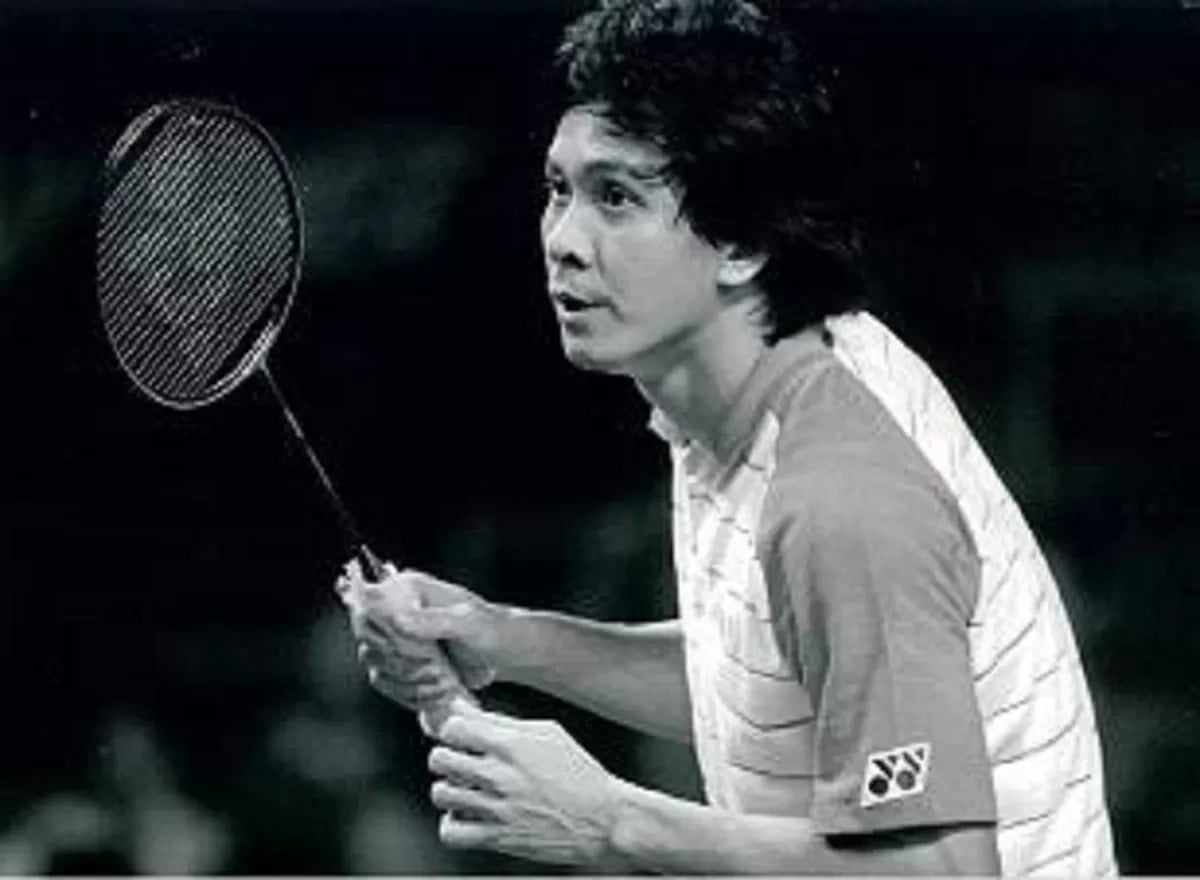
Kudus – Liem Swie King is celebrated as an Indonesian badminton legend, renowned for his signature jumping smash. Throughout his career, he secured numerous international accolades, including three All England titles and a gold medal at the 1978 Asian Games.
Liem Swie King is one of Indonesia's most storied badminton legends, widely known by his nickname, the King of Smash. Born in Kudus, Central Java, on February 28, 1956, he gained global recognition for his powerful and rapid jumping smash, which defined his aggressive style of play on the court.
Swie King first captured international attention when he challenged fellow Indonesian legend Rudy Hartono in the final of the 1976 All England. At the time, Swie King was just 20 years old, and the performance marked his emergence as the successor to Hartono at the world's most prestigious tournament.
Over the course of his career, Swie King reached the All England final six consecutive times (1976–1981). He successfully captured three titles during that run, in 1978, 1979, and 1981.
Furthermore, Swie King amassed dozens of titles across various international badminton Grand Prix events, cementing his status as a dominant force in the sport from the late 1970s through the early 1980s.
Swie King's journey in badminton began in his hometown of Kudus, where he was encouraged by his parents to take up the sport. His talent flourished after joining PB Djarum, a club widely recognized for producing many of Indonesia’s national athletes.
His breakthrough arrived in 1972 when he became the Central Java Junior Champion. A year later, at age 17, he competed in the 1973 National Sports Week (PON), earning a performance that led to his recruitment into the National Training Center at Hall C Senayan.
On the national stage, Swie King secured back-to-back victories at the National Championships in 1974 and 1975, solidifying his position as one of the country's top players.
Internationally, Liem Swie King achieved significant milestones for Indonesia. In addition to his three All England titles, he captured the men's singles gold medal at the 1978 Asian Games in Bangkok.
Swie King was also a pivotal member of the Indonesian Thomas Cup team. He represented the national squad six times, contributing to three championship titles for Indonesia in 1976, 1979, and 1984.
His fast-paced, courageous, and unrelenting playing style made him one of the most respected figures in world badminton during his era.
After a 15-year career in professional badminton, Liem Swie King retired from the national team in 1988. Initially, he faced challenges transitioning to life outside of the sport, given his primary expertise was centered on athletics.
He eventually pivoted to business, assisting with the management of a hotel owned by his in-laws in the Melawai district of South Jakarta. This experience paved the way for him to develop his own ventures, specifically in the health massage and spa industry.
The business grew to include several branches, including locations in Grand Wijaya Centre, Fatmawati, and Kelapa Gading. These businesses have employed hundreds of staff and served a diverse clientele, including expatriates.
Beyond his status as a badminton legend, Liem Swie King serves as an inspiration for the next generation of Indonesian athletes. His life story even influenced a film about the Indonesian badminton scene, produced by the Alenia production house.
While the film was not a direct biography, the character representing Swie King is depicted as an inspirational figure who motivates a father to encourage his own child to strive for championship status in badminton.
To this day, Liem Swie King remains one of the greatest Indonesian badminton legends, remembered for bringing glory to the nation on the global stage through his achievements and iconic style of play.